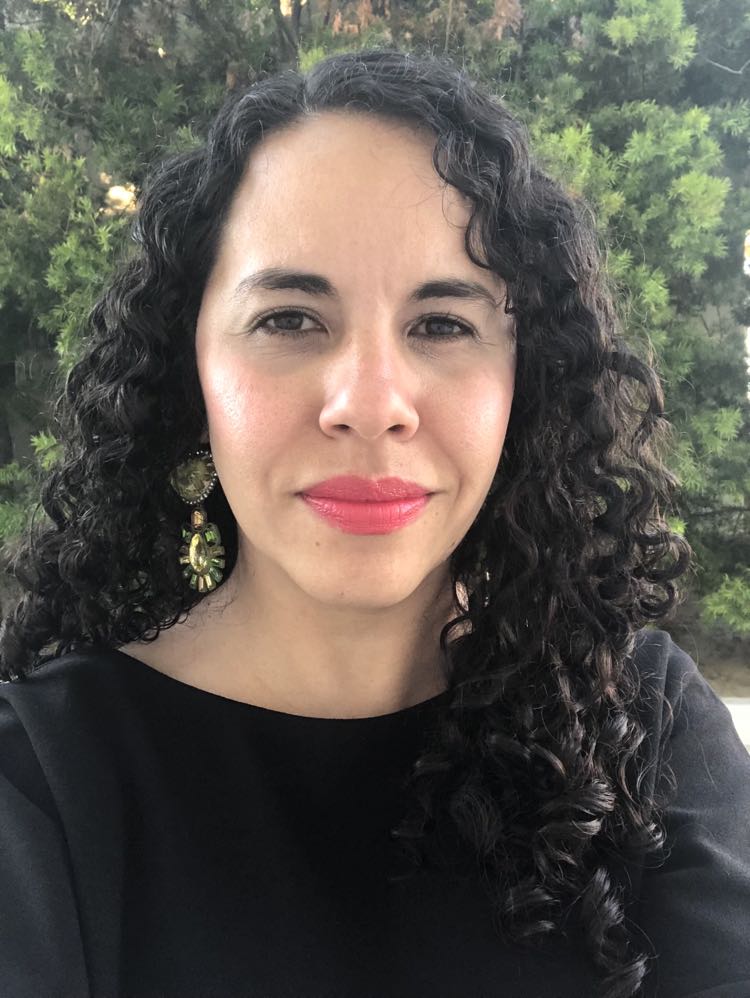
Jeannette Acevedo Rivera holds a PhD in French and Spanish nineteenth-century literature from Duke University. She is currently an Associate Professor of Spanish at California State University, Long Beach. Her comparative research examines intersections among gender, material culture, fashion, and the practice of writing and collecting. She is currently working on her book manuscript, which explores the development of the album phenomenon in nineteenth-century France and Spain. Jeannette approaches this trend and object considering its role as an archival resource, literary topic, and feminized cultural practice. Her analysis of the album is based on the depiction of this craze in nineteenth-century literature (essays on social customs, novels, plays, and short stories) and on the more than 35 historical albums she has consulted in archives in France and Spain. She has been invited to present on this topic at the Museo del Romanticismo, in Madrid, and at the University of San Diego, in California. Jeannette’s work has been published in Nineteenth-Century Contexts, Nineteenth Century Studies, Decimonónica, Bulletin of Spanish Studies, and other academic venues. In 2022, she received the Nineteenth-Century Studies Association’s Inaugural BIPOC Scholars Prize for her article, “’One Should Never Write in Albums’: Analyzing Nineteenth-Century Albums as Social Networks.” Jeannette is a native from the countryside of Puerto Rico and was a first-generation college student.
If you had the ability to tour the nineteenth century for one hour and you could visit as many places / attend as many events as possible, regardless of distance, how would you build your itinerary?
Like my research, this imaginary nineteenth-century tour will be transnational and include French and Spanish places, events, and encounters that I will experience in chronological order. Since one hour is a tad limited for all the things I would like to see and do, I will use a fantastic method that allows me to defy traditional notions of time and experience hours in just minutes.
15 minutes: I will start my tour at the Salon of the Arsenal, in Paris, which was headed by Charles Nodier while he was the librarian of the Arsenal Library from 1824 to 1844. There, I will listen to important figures of the French literary scene, such as Alexandre Dumas, Victor Hugo, and Alfred de Musset. Of course, I will bring my album and ask all the writers in attendance for a contribution. This is precisely what Nodier’s wife and daughter did at the salon their illustrious husband and father hosted. (If you are not familiar with albums, check out this article I wrote about said trend!)
10 minutes: From the Arsenal I will move to the west of the French capital and visit the house where Honoré de Balzac lived from 1840 to 1847 (which nowadays is the museum Maison de Balzac). My goal will not be to have a conversation with the renowned writer, but to witness one of his encounters with the many debt collectors who visited him to collect the money he owed. Balzac was in serious financial trouble, and some say that he had to hide from the creditors and merchants who followed him throughout the city and even to his house. This part of the tour will be entertaining, yet tragic.
10 minutes: For the next step I will go to the Seine River to find Spanish writer, Benito Pérez Galdós. He visited Paris for the first time in 1867, and one of the things he most enjoyed was discovering the “bouquinistes,” or booksellers, along the banks of the river. There he bought a copy of Balzac’s Eugénie Grandet and let himself be carried away by the French writer. I will walk with Galdós along the Seine and get some books for myself, as well.
15 minutes: The encounter with Galdós will facilitate my transition to Spain for the second part of my tour. In Madrid, I will visit several emblematic places from his oeuvre. First, I will have lunch at the Botín Restaurant, where characters in Galdós’s Fortunata and Jacinta (1887) eat. Then, I will go to the Parroquia de San Sebastián and give some money to the beggars who, in the novel Compassion (1897), install themselves there looking for the charity of those attending mass. My meager act of generosity will be followed with a coffee at the Fontana de Oro, a popular coffee house where Galdós located his first novel, homonymous and published in 1870 (nowadays it is an Irish pub!).
10 minutes: I will finish my tour of the nineteenth century by snooping on one of the romantic encounters between Galdós and Galician writer, Emilia Pardo Bazán, which took place between 1888 and 1889. This affair is perhaps the most important in nineteenth-century Spanish literary history, not only because of the status of both writers, but also because Pardo Bazán was a separated (but still married!) woman. Hopefully I will be able to hear one of the conversations in which they commented on each other’s writings in progress, for a mix of romance with literary criticism.
What movie, TV show, or book set in the nineteenth century most resonates with you?
Oh, this is a difficult one! I will have to go with a book that was pivotal in my decision to study the nineteenth century, Madame Bovary. I originally read this novel as an undergraduate student at the University of Puerto Rico (in Spanish!) and was absolutely fascinated by the story and captivated by the narrative style. How could the author describe characters, objects, feelings, and impressions in such detail?! I still didn’t know what Realism was, but I was all in. The protagonist of the novel, Emma Bovary, awakened in me an uncanniness that I had never before experienced with a literary character. She was curious and eager in a dangerous way. Her ennui of provincial life and her desire to experience the city resonated with me as someone who grew up in the countryside and was at that age (19-20 y/o) starting to discover urban life. I still remember reading the quote below and vividly imagining Emma with her map and, in a metafictional fashion, everything she was visualizing:
“She bought a plan of Paris, and with the tip of her finger on the map she walked about the capital. She went up the boulevards, stopping at every turning, between the lines of the streets, in front of the white squares that represented the houses. At last she would close the lids of her weary eyes, and see in the darkness the gas jets flaring in the wind and the steps of carriages lowered with much noise before the peristyles of theatres.”
Madame Bovary was my introduction to literary Realism and to the complexities of gender representation in literature. The description of the tragic ending of the protagonist, as brutal as it is, transmits something that to this day mesmerizes me.
What nineteenth-century sound would you love to hear?
The city! I would love to hear all the sounds of the city as they coexisted in that space. Carriages would be a particularly important element of that auditorial landscape, since their wheels moving through the cobblestone streets and the horses’ hooves clopping on the ground conveyed the agitation of urban life. As carriages approached, some people would yell at distracted pedestrians to get out of the way, while the bells from churches would mingle with those of the young boys selling newspapers.
If you threw a nineteenth-century-themed party, what would it be like, and what would it be for?
My nineteenth-century-themed party would definitely be an album gathering! I would organize this celebration to get friends together and escape for a little while from our overwhelming twenty-first century realities. Nineteenth-century dress and accessories would be strongly suggested (including hats, pocket watches, reticules, etc.). Like two centuries ago, guests would bring their albums to collect contributions from their acquaintances, friends, and, perhaps, even suitors. In its nineteenth-century iteration, album exchanges were determined by gender and class restrictions: women were album owners, men were contributors, and this trend was specific to higher social classes. My album party will, of course, be more inclusive, with women creating album entries, men being album owners, and no class distinctions.
At this party, all guests will bring their albums and collect contributions in the form of poetry, drawings, and music scores that convey their social networks. As everyone will be required to create and collect, the gathering will promote artistic expression and personal interaction equally. Thus, it will be important for each guest to fulfill both roles throughout the night, in order for them to leave with a valuable collection in their album and their signature scrawled in multiple other albums. I imagine it will not be difficult for my contemporary friends to successfully participate in the album practice, as the type of interaction that this trend requires is not too distant from that of the yearbooks used in the in the late twentieth century to collect classmates’ signatures.